
Trace a Hardy Address to Its Owner
Start with the parcel, not the name. Enter the physical address in the WV Property Viewer. Open the detail panel and note the parcel ID. The Assessor record supplies the tax owner display, and the legal description from the viewer keeps the search tied to one piece of land. Carry that name to the County Clerk. The newest recorded deed there names the grantee, the party receiving the land. Before accepting a match, compare the deed's land description against the tax parcel.
This answers who owns the parcel according to the records. It cannot say who lives there. A new deed may lag the assessment file. When the name is an LLC or an estate, follow that exact legal name in the proper source rather than guessing at the person behind it.
- Search the physical E-911 address in the state Viewer and open the parcel detail.
- Record the full parcel ID, owner display, situs address, mailing address, and legal description.
- Search the latest deed by grantee or parcel reference through Hardy County Clerk Online Records.
- Compare the legal description and deed date with the tax parcel; check the entity name separately if needed.
Hardy Owner Sources Show Different Dates
The same parcel shows up in several Hardy and state records. Yet each source does one job on its own update cycle. The Assessor roll is a tax owner snapshot. The County Clerk's deed index records an instrument. GIS detail ties a displayed owner to the parcel's surface geometry. The SOS database describes a business entity instead. Compare dates and parcel descriptions rather than asking one source to answer everything.
| Source | Owner Information | Access and Timing |
|---|---|---|
| WV Property Assessment / Assessor | Owner display, parcel, mailing and situs details where available | Free; state data is updated annually |
| Hardy County Clerk | Grantee named on a recorded deed | Paid online index or counter; online cutoff not published |
| WV SOS Business Search | Entity, agent, officer, and address clues | Free search; advanced filters and paid CSV option |
| WV Property Viewer | One owner may show in the list; detail adds attributes | Free statewide viewer; geometry can lag paper changes |
| Hardy Sheriff tax ticket | Tax account owner, care-of and mailing fields | Free ticket search; use current result for payment status |
The owner of record is not always the user. A company, trust, estate, or co-owners can hold title. The tax mailing address may belong to a representative, or sit far from the parcel.
Open the Hardy Parcel Detail
A WV Viewer result list often shows just one owner and the physical address. Opening the parcel reveals more. It can include the owner's mailing address, which matters when a deed names two co-owners or an entity. Keep the situs and mailing addresses in separate notes. One shows where the land sits. The other is where tax mail goes.
A Hardy Sheriff tax ticket adds an owner name, a care-of line, a mailing address, map and parcel numbers, a subparcel, special ID, legal description, and deed book and page. That deed reference bridges you to the Clerk but does not replace opening the deed itself. Use it to verify the grantee. Check the land description too.
- Owner of record
- The owner name shown in an official tax or deed record, as of that record's date.
- Grantee
- The person or entity receiving the interest named in a deed.
- Situs address
- The physical location used to place the parcel.
- Mailing address
- The address used for tax or owner correspondence; it may differ from situs.
- Vesting
- The way ownership is held in the deed, such as by an individual or entity.
When a Hardy Owner Is a Company
Hardy deeds and tax tickets often name an LLC or another organization as grantee or owner. Search that exact legal name in the West Virginia Secretary of State Business Organization Search. The basic search covers organization, agent, and officer fields. Advanced search adds street, city, county, state, organization type, dates, active or inactive status, and business-purpose codes. It can also return agent and officer details. Those help distinguish similar entity names.
Treat Secretary of State data as a clue about identity and registered contacts, not proof of current ownership. The deed is the proof. Confirm the parcel's newest deed at the County Clerk. An inactive business status, standing alone, neither transfers title nor changes the recorded deed.
Entity names can look alike. The WV advanced business search includes a Hardy County filter and organization details that help separate them.
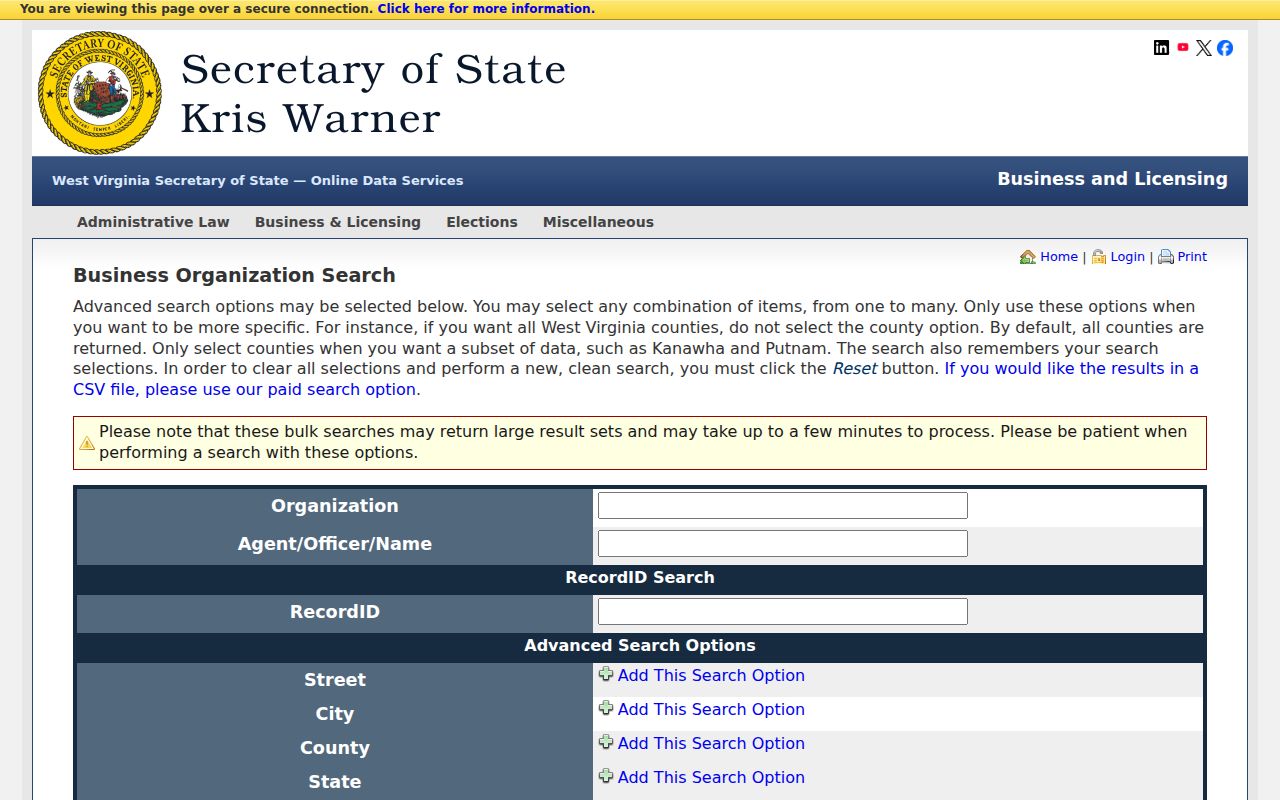
Let the entity result settle the business name. Then return to the deed for proof of the property transfer.
Hardy Mailing and Situs Names Can Split
Hardy properties sometimes carry a mailing city that sits outside any incorporated boundary. Moorefield and Wardensville are the only two incorporated municipalities listed. The official county profile lists no others. So remaining communities and postal names are not additional towns. A ZIP code proves nothing about town limits.
The WV Viewer's address search relies on an E-911 physical address. It rejects rural routes and PO boxes. A tax ticket's mailing address may point to a separate residence. It may also point to a business, a care-of contact, or an out-of-county location. Read situs beside the legal description. Edge parcels deserve extra care. Compare the town boundary record with the Hardy tax district instead of assuming anything from the mail city.
A Hardy Sale Can Outrun the Tax Roll
The state updates its assessment Viewer once a year. That timing creates a gap. A deed recorded in Hardy can name a new grantee while the parcel screen still lists the prior owner. West Virginia gives assessors a deadline for catching up: for transfers between July 1 and June 30, revised tax maps are due by February 1 of the following year. Two years is the state's own benchmark. If a new line stays unchanged that long, contact the local Assessor. For a current owner question, treat the newest deed as the transfer record. Treat the Assessor as a tax snapshot. Note both dates. When the names differ, ask the Hardy Assessor about the assessment update, then use the Clerk's recording reference to explain the change; the gap is usually timing, not a conflicting conveyance.
Hardy Parcels Link Owner Records
A full West Virginia parcel ID carries six parts: county, district, map, parcel prefix, parcel suffix, and special ID. Other systems drop pieces or trim zeros. Save the Viewer format exactly. Then compare it against the map, land book, tax ticket, and deed reference. It cuts confusion from spelling variants and same-name owners. Hardy's tax-ticket sample shows the join clearly. One record lists map, parcel, subparcel, special ID, owner, description, and deed book and page. Follow that cross-reference to the recorded deed. It keeps the search from drifting onto nearby land, though a GIS line remains reference geometry, not the legal description.
Where Hardy Owner Records Are Held
Each Hardy office answers a different question about ownership. The County Clerk records the transfer. The Assessor keeps the tax owner and value view. The Sheriff's ticket shows the tax-account owner along with mailing fields, and the WV Property Viewer ties parcel detail to mapped geometry. Read each source's date and role before trusting a name; these are complementary records, not four copies of a title certificate.
| Source | Owner Info It Gives | Access |
|---|---|---|
| Assessor / tax roll | Owner display, mailing address, value and parcel context | Free state and county tools; annual state release |
| County Clerk deed index | Grantee and recorded legal description | Paid online index or counter |
| WV Secretary of State | Entity name, agent, officer, and organization address | Free online search; entity context only |
| WV Property Viewer | Parcel ID, map, physical address, detail attributes | Free; open detail because list shows one owner |
These records name the owner of record for a purpose, not whoever lives there now. A mailing address may point to an agent. A recorded deed can outrun the tax display. Compare the parcel description and dates, then rely on the latest deed to confirm the transfer.
Limits of a Hardy Owner Lookup
A Hardy owner lookup reveals who appears in a public assessment or recorded deed. It cannot show who lives at the address. It cannot prove a beneficial owner. Nor can it clear every claim to title. West Virginia keeps property map data public, yet phone numbers and security-alarm details are redacted from release. Birth, death, marriage, and divorce records carry statutory opening periods. Treat them as closed files, not open owner records. The County Clerk's page posts a Fraud Detection link. Confirm any property-fraud signup through the office itself. Use official contact details for a suspected forged deed or a suspicious payment demand. Keep the inquiry tied to a parcel or recorded instrument, and never copy private details from a document image.
Lawful use. A Hardy owner lookup is for property research, purchase diligence, and civic use. Do not use an owner's details to stalk, threaten, or harass anyone.